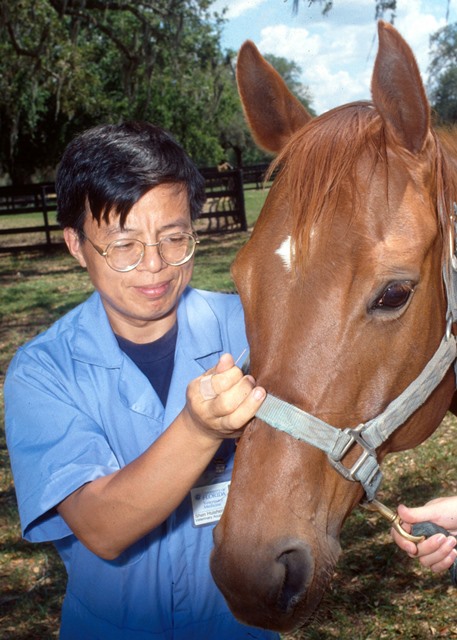
Information provided by Dr. Justin Shmalberg and Dr. Huisheng Xie.
What is acupuncture?
Acupuncture is defined as the stimulation of a specific point on the body with a specific method, resulting in a therapeutic homeostatic effect. The specific point on the body is called “Shu-xu” or acupuncture point (acupoint). The ancient Chinese discovered 361 acupoints in humans and 173 acupoints in horses.
Modern research shows that acupoints are located in the areas where there is a high density of free nerve endings, mast cells, small arterioles, lymphatic vessels and the dense connective tissue represents a different spatial configuration as compared to the rest of the normal skin. A great number of studies indicate that stimulation of acupoints induces the release of β – endorphin, serotonin and other neurotransmitters. Therefore, acupuncture for pain relief is well supported by these scientific studies. As more studies are conducted, the mechanism of this ancient therapy will be better understood.
What is the history of acupuncture?
Acupuncture has been practiced in both animals and humans for thousands of years in China. The earliest veterinary acupuncture book “Bo Le Zhen Jing” (Bole’s Canon of Veterinary Acupuncture) is believed to have been written by Dr. Bo Le in the Qin-mu-gong period( 659BCE to 621BCE). Veterinary treatment protocols using acupuncture are well documented in this textbook. Since then, acupuncture was, and still is, a part of the mainstream veterinary medical system in China. Veterinary acupuncture has been practiced in China for more than 2,000 years. Interest and activity spread to other Asian countries such as Japan and Korea about 1,500 years ago. For the past 30 years, there has been tremendous growth and development of acupuncture in animals in Europe and the United States.
The benefits of acupuncture have been documented in an increasing number of clinical trials and, as a result, we have a better understanding of acupuncture’s method of action. Our patients greatly benefit from these new developments.
What can acupuncture help?
Clinical trials indicate that acupuncture therapy can be effective in the following conditions:
Musculoskeletal problems: Lameness, muscle soreness, back pain, disc problems, arthritis, osteoarthritis and degenerative joint disease, laminitis, navicular disease, sport-related injuries including tendons and ligaments, muscle, joint and bone injuries.
Performance enhancement: Immune system stimulation and the prevention of disease.
Cautions and contraindications
Acupuncture is cautiously used, or may be contraindicated with the following conditions:
Fracture
Pregnancy
Open Wound
Infectious diseases
Is acupuncture painful?
Acupuncture is a very safe medical procedure when administered by a qualified practitioner.
A proper acupuncture treatment may induce distention, and heaviness sensation along with contraction, of local muscle. More than 95% of patients are comfortable with acupuncture therapy. Due to the relaxation effect, some animals will fall asleep during acupuncture treatment. Sedation is not recommended before acupuncture treatment, as it may interfere with the acupuncture effect.
What physiological effects are induced by acupuncture?
Numerous studies show that acupuncture stimulation induces the following physiological effects:
Analgesic effect
Regulation of gastrointestinal motility
Anti-inflammatory effect
Immuno-regulation
Hormone and reproductive regulation
Anti-febrile effect; microcirculation promotion
How does acupuncture work?
Moxibustion
Acupuncture may be defined as the stimulation of a specific point on the body, referred to as an acupoint. Physiological changes in response to acupuncture point stimulation are the basis of clinical treatment. Stimulation of an acupoint activates nerve fibers which conduct electrical signals that release endorphins and other neurotransmitters.
Many techniques have been developed to stimulate acupoints such as:
Dry-needle: An acupuncture needle is inserted in an acupoint for stimulation of that point. The needles are thin, filiform, sterile, and of varying widths and lengths.
Moxibustion: An acupoint is warmed, causing activation of the point. It uses crushed dried leaves of Artemisia argyi rolled into a cigar-shaped fashion. The herb is burned and then placed over an acupoint without touching the skin. The warming effect of the burned herb causes stimulation of the acupoint.
Tuina medical manipulation : A Veterinarian uses their hands and fingers to apply direct pressure or adjustment to an acupoint. Each point requires about 1-5 minutes of constant pressure for stimulation.
Hemo-acupuncture: A hypodermic needle is inserted into a blood vessel that contains an acupoint to draw a few drops of blood. The purpose of this modality is to release heat from the body.
Electro-acupuncture: An electrical lead is attached to dry-needles and connected to an electro-acupuncture machine which is used to control the frequency and amplitude applied to each point. This allows for more effective stimulation than dry-needle alone.
Pneumo-acupuncture: Fresh sterilized air is injected into an acupoint, creating an air bubble within the subcutaneous tissues causing stimulation of the acupoint. This modality can be used for muscle atrophy.
Aqua-acupuncture: A soluble, sterile medium is injected into acupoints. The purpose is to provide a constant stimulation via the pressure induced by the liquid injected into the acupoint. The most commonly injected substances are sterile water, saline, or vitamin B12.
How many treatments are needed?
The number of treatments depends on the condition, how long the condition has been present, and the age of the animal. Acute conditions resolve quickly within 1-3 treatments. Chronic conditions resolve more slowly; usually within 4 -10 treatments. Some degenerative conditions may need monthly maintenance treatments.
References
2008: Xie H. Traditional Chinese Veterinary Medicine. Ed Jing Tang Press. USA.
Shmalberg J, Xie H. Earth/Spleen element syndromes; in Xie H, Wedemeyer L, Chrisman C (eds). Practical Guide to Traditional Chinese Veterinary Medicine: Emergencies and Five Element Syndromes. 2014: 141-192.
Shmalberg J. Acupuncture: history and application. Clinician’s Brief. April 2014: 59-61.
Shmalberg J. Treatment of obesity: current research and recommendations. Today’s Veterinary Practice. 2013; 3(5):60-65.
Shmalberg J, Hill RC, Scott KC. Nutrient and metal analyses of Chinese herbal products marketed for veterinary use. Journal of Animal Physiology and Animal Nutrition. 2013; 97(2):305-314.
Shmalberg J, Xie H. Acupuncture and Chinese herbal medicine for treating horses. Compendium. 2011; 33(5): online at vetlearn.com.
Shmalberg J, Xie H. The clinical application of equine acupuncture. Journal of Equine Veterinary Science. 2009; 29(8):645-652.
As part of both the Institute of Food and Agricultural Sciences and UF Health, Veterinary Medicine is dedicated to advancing animal, human and environmental health through teaching, research, extension and patient care.
Need animal care? Visit the UF Small Animal and Large Animal Hospitals. From dogs, cats, birds and exotics to horses, cattle, llamas, pigs and many other large farm or food animals, our experienced veterinary staff is ready to assist.
Animal Airwaves is a daily radio series that features one-minute segments relating to animal health, ranging from insights into animal behavior to veterinary patient care breakthroughs and trends.